
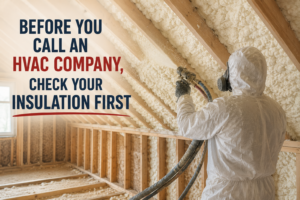
Before You Call an HVAC Company, Check Your Insulation First
- Is Your House Too Hot Upstairs?
- Too Cold in Winter?
- Pests in the attic?
- Moisture or Mold issues or concerns?
- Drafts?
- Odors from Attic or Basement?
- Cold Feet in the Winter?
- Indoor or Outdoor noise issues?
- Water spots on your ceiling?
- Utility Bills Climbing?
When your home feels uncomfortable, most homeowners immediately think, “I need my furnace or air conditioner checked.”
Sometimes that’s true. If your HVAC system won’t turn on, isn’t blowing air, or has completely failed, call an HVAC professional.
But if your system runs constantly, struggles to keep up, or some rooms are always hotter or colder than others, your HVAC equipment may not be the real problem.
In many homes, the insulation and air sealing are the real culprits.
Your HVAC System Can Only Condition the Air It Has
Think of your home like a cooler.
If the lid doesn’t seal and the insulation is thin, adding more ice won’t keep your drinks cold for long. The cold simply escapes.
Your HVAC system works the same way.
If your home has:
- Poor attic insulation
- Air leaks around top plates, wiring, plumbing, or recessed lights
- Under-insulated walls
- Leaky rim joists
- Drafty crawlspaces or basements
…your heating and cooling are constantly escaping outdoors.
Your HVAC system has to work harder and longer just to maintain the temperature.
Bigger HVAC Equipment Doesn’t Fix Energy Loss
Many homeowners assume the answer is:
- A larger air conditioner
- A bigger furnace
- Replacing equipment – VERY expensive!
Unfortunately, installing larger equipment without fixing the building envelope is like pouring water into a bucket with holes.
The new system may:
- Cycle on and off more often
- Wear out faster
- Use more electricity or gas
- Still leave uncomfortable rooms
You’ve spent thousands of dollars without solving the actual problem.
The Building Envelope Is Your Home’s First Line of Defense
Your home’s building envelope includes:
- Attic insulation
- Wall insulation
- Crawlspace or basement insulation
- Air sealing
- Rim joists
- Windows and doors
- Weatherstripping
- Ventilation
Together, these components keep conditioned air inside and outdoor temperatures where they belong.
A properly insulated home allows your HVAC system to do its job efficiently instead of constantly fighting heat loss and heat gain.
Common Signs Your Insulation May Be the Problem
If you experience any of these, it’s worth evaluating your insulation before replacing HVAC equipment:
- Upstairs is much hotter in summer.
- Certain rooms are always colder.
- Your furnace or AC runs almost continuously.
- Utility bills continue increasing.
- Drafts near windows, doors, or outlets.
- Ice dams during winter.
- Hot or cold ceilings.
- Rooms become uncomfortable shortly after the HVAC shuts off.
- Dust, allergens, or outdoor odors entering the home.
- Excess humidity or moisture issues.
The Right Order Saves Money
The most cost-effective approach is usually:
Step 1: Evaluate the Home
Inspect insulation levels, air leakage, moisture concerns, and overall building performance.
Step 2: Improve the Building Envelope
Seal air leaks and upgrade insulation where needed.
Step 3: Evaluate HVAC Performance
Once your home is holding conditioned air properly, an HVAC professional can determine whether your existing equipment is appropriately sized or if repairs or replacement are necessary.
Many homeowners discover their current system performs much better after improving insulation and air sealing.
Comfort Is About More Than Temperature
A comfortable home isn’t simply one with an expensive heating and cooling system.
Comfort comes from:
- Consistent temperatures throughout the home
- Lower humidity in summer
- Fewer drafts
- Better indoor air quality
- Reduced outside noise
- Lower utility bills
- Less wear and tear on HVAC equipment
Proper insulation helps achieve all of these.
Our Philosophy: Fix the Cause, Not Just the Symptoms
At Kansas Spray Foam Insulation, we believe every homeowner deserves answers—not just a sales pitch.
That’s why we start with a whole-home building envelope evaluation to identify where your home is losing energy.
Our evaluation looks at how insulation, air sealing, moisture, and the building envelope work together so you can make informed decisions that improve comfort, energy efficiency, and long-term savings.
Sometimes the solution is adding insulation.
Sometimes it’s air sealing.
Sometimes it really is an HVAC repair or replacement.
The key is knowing which problem you’re actually solving before investing thousands of dollars.
Schedule a Home Comfort Evaluation
If your home feels uncomfortable, your utility bills seem too high, or your HVAC system never seems to stop running, start with the building envelope.
A professional insulation evaluation can help determine whether your home is losing conditioned air before you spend money replacing heating and cooling equipment.
Fix the envelope first. Then let your HVAC system do what it was designed to do—keep your family comfortable.